Mental Health Policy Advocacy A Comprehensive Guide
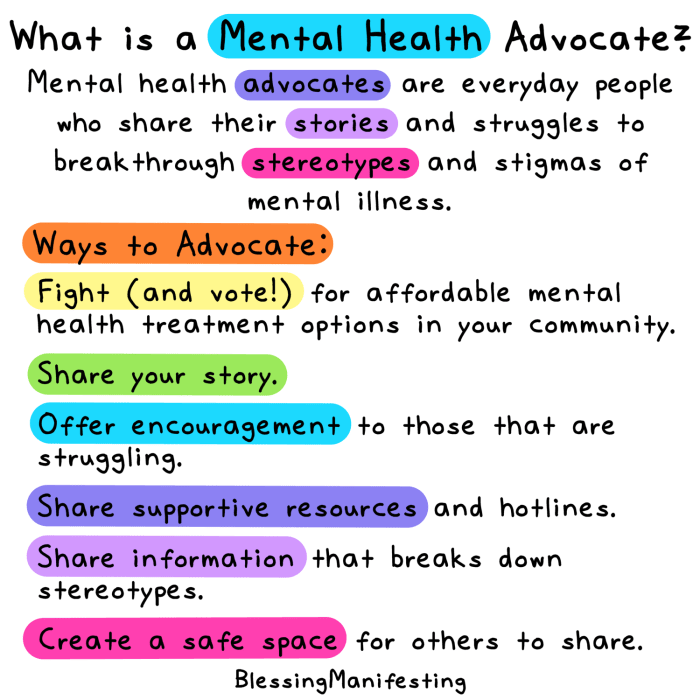
Mental health policy advocacy is crucial for ensuring equitable access to mental healthcare. This guide explores the multifaceted nature of this field, examining the key players, successful campaigns, and the evolving role of technology. We’ll delve into the complexities of current policies, highlighting gaps and advocating for improved systems. Understanding the interplay between policy, access to care, and individual well-being is paramount to fostering a society that prioritizes mental health.
From analyzing existing mental health legislation across various jurisdictions to designing innovative advocacy campaigns targeting underserved populations, this exploration aims to equip readers with a thorough understanding of the landscape. We will also examine practical strategies for stress and anxiety management, depression support, and building resilience, connecting individual well-being to broader policy goals.
Defining Mental Health Policy Advocacy

Mental health policy advocacy is the act of influencing policy decisions to improve mental healthcare access, quality, and affordability. It involves a multifaceted approach, combining education, collaboration, and strategic action to achieve systemic change. Successful advocacy hinges on a deep understanding of the political landscape, effective communication strategies, and a commitment to amplifying the voices of those most affected by mental health challenges.Advocacy for mental health policy rests on several core principles.
These include promoting human rights and reducing stigma surrounding mental illness, ensuring equitable access to quality care regardless of socioeconomic status or geographic location, prioritizing evidence-based practices and policies, and fostering collaboration among diverse stakeholders to achieve common goals. Transparency and accountability are also critical, ensuring that advocacy efforts are ethical and impactful.
Stakeholders Involved in Mental Health Policy Advocacy
A wide range of individuals and organizations play crucial roles in advocating for improved mental health policies. Government agencies at all levels (local, state, and federal) are key decision-makers, responsible for enacting and enforcing legislation. Healthcare providers, including psychiatrists, psychologists, social workers, and nurses, offer invaluable expertise on the effectiveness of various treatments and service delivery models. Advocacy groups, such as the National Alliance on Mental Illness (NAMI) and the Mental Health America (MHA), represent the interests of individuals with mental health conditions and their families, providing crucial support and pushing for policy changes.
Finally, individuals with lived experience of mental illness are essential voices, offering firsthand accounts and perspectives that shape policy debates and inform effective solutions.
Examples of Successful Mental Health Policy Advocacy Campaigns
Several successful campaigns illustrate the power of advocacy in improving mental health outcomes. The passage of the Mental Health Parity and Addiction Equity Act of 2008 in the United States, which mandated equal coverage for mental health and substance use disorder treatment under health insurance plans, is a significant example. This landmark legislation was the result of years of advocacy by numerous organizations and individuals.
Another example is the growing movement towards integrating mental healthcare into primary care settings. Advocates have successfully pushed for increased funding and training for primary care providers to screen for and treat common mental health conditions, thereby increasing access to care for underserved populations. These campaigns demonstrate the impact of sustained, collaborative efforts.
Hypothetical Mental Health Policy Advocacy Campaign Targeting Underserved Populations
A hypothetical campaign could focus on improving access to mental healthcare for homeless youth. This population faces significant barriers to care, including lack of stable housing, limited access to transportation, and stigma. The campaign would involve multiple phases. Firstly, a thorough needs assessment would be conducted to identify the specific challenges faced by homeless youth in accessing mental health services.
This would inform the development of targeted policy recommendations, such as increased funding for mobile crisis response teams specifically trained to work with this population, expansion of outreach services in homeless shelters and youth centers, and the creation of culturally sensitive and youth-friendly mental health programs. Secondly, the campaign would build a coalition of stakeholders including homeless shelters, youth organizations, mental health providers, and government agencies.
Finally, the coalition would advocate for the implementation of the policy recommendations through lobbying, public awareness campaigns, and community engagement activities. The success of this campaign would be measured by increased access to mental health services among homeless youth, improved mental health outcomes, and reduced rates of homelessness.
Analyzing Current Mental Health Policies
Effective mental health policy is crucial for ensuring access to quality care and improving outcomes for individuals struggling with mental illness. Analyzing existing policies across various jurisdictions reveals significant variations in approach and effectiveness, highlighting areas needing improvement and informing future policy development.A comparative analysis of mental health policies reveals a complex landscape. For example, some countries, like the United Kingdom, have implemented comprehensive national strategies emphasizing integrated care and early intervention, while others, such as the United States, rely more on a decentralized system with varying levels of support across states.
This disparity reflects different healthcare models, funding mechanisms, and societal priorities.
Mental Health Policy Gaps and Shortcomings, Mental health policy advocacy
Existing mental health policies frequently fall short in several key areas. A common deficiency is inadequate funding, leading to limited access to services, long waiting lists, and a shortage of qualified professionals. Many policies also lack sufficient focus on early intervention and prevention, resulting in delayed treatment and increased severity of illness. Furthermore, the stigma surrounding mental illness often hinders individuals from seeking help, even when services are available.
Effective policies must address these systemic issues to improve outcomes. Another significant gap is the lack of culturally competent care, particularly for marginalized communities who may face additional barriers to accessing services.
Impact of Current Mental Health Policies on Access to Care and Treatment
The impact of current mental health policies on access to care is multifaceted and often uneven. In countries with robust national strategies and adequate funding, individuals generally experience better access to a wider range of services, including early intervention programs, medication management, and psychosocial therapies. However, even in these settings, disparities exist based on factors such as geographic location, socioeconomic status, and insurance coverage.
In contrast, countries with less developed mental health systems often experience significant barriers to care, including limited availability of services, long waiting times, and a lack of qualified professionals. This can lead to delayed or inadequate treatment, resulting in poorer outcomes and increased societal costs. For example, a study in [Insert Country/State] showed a direct correlation between inadequate funding for community mental health centers and increased hospitalizations for individuals with schizophrenia.
Key Elements of a Well-Structured Mental Health Policy Document
A well-structured mental health policy document should include several key elements to ensure clarity, comprehensiveness, and effectiveness. These include a clear statement of goals and objectives, a comprehensive assessment of the current mental health landscape, a detailed description of proposed interventions and strategies, a plan for implementation and monitoring, and a mechanism for evaluation and improvement. Furthermore, the document should identify specific targets and measurable outcomes to track progress and ensure accountability.
For instance, a policy might aim to reduce suicide rates by a certain percentage within a specified timeframe, with specific interventions and monitoring mechanisms Artikeld to achieve this goal. Finally, a robust policy should address resource allocation, funding mechanisms, and stakeholder engagement to facilitate successful implementation and sustainability.
The Role of Technology in Mental Health Policy Advocacy
Technology is rapidly transforming healthcare, and mental health is no exception. Its potential to enhance service delivery, increase access, and inform policy development is significant. This section explores how technology is currently being utilized in mental health policy advocacy and Artikels strategies for its effective deployment.
Improving Mental Health Service Delivery and Access Through Technology
Technological advancements offer promising solutions to overcome barriers in accessing mental healthcare, particularly for underserved populations. Telehealth platforms, for example, enable remote consultations, reducing geographical limitations and travel burdens. Mobile apps provide readily accessible self-management tools, including cognitive behavioral therapy (CBT) exercises and mood tracking functionalities. These technologies can significantly improve treatment adherence and outcomes, especially for individuals who might otherwise struggle to attend in-person appointments.
Furthermore, AI-powered chatbots can offer immediate support and triage, providing preliminary assessments and connecting individuals with appropriate resources. The integration of electronic health records (EHRs) streamlines data sharing and improves coordination of care among providers.
Examples of Technology’s Current Use in Mental Health Policy Advocacy
Several organizations are leveraging technology to advance mental health policy. For instance, advocacy groups utilize social media platforms to raise awareness, share personal stories, and mobilize support for policy changes. Data visualization tools are employed to present compelling evidence of the economic and social burden of mental illness, influencing policymakers’ decisions. Online petitions and digital campaigns have proven effective in garnering public support for specific legislative initiatives.
Furthermore, some organizations utilize data analytics to track the effectiveness of existing mental health policies and identify areas needing improvement.
A Plan for Utilizing Social Media to Promote Mental Health Awareness and Advocacy
A comprehensive social media strategy is crucial for effective mental health advocacy. This plan would involve: 1) Identifying key platforms (e.g., Twitter, Instagram, Facebook) frequented by the target audience (policymakers, the public, etc.). 2) Creating engaging content, including infographics, videos, and personal stories, that convey compelling narratives and statistics about mental health issues. 3) Utilizing relevant hashtags to increase visibility and reach.
4) Engaging in conversations with followers, responding to comments and questions promptly. 5) Collaborating with influencers and organizations to amplify the message. 6) Tracking key metrics (e.g., engagement, reach, website traffic) to assess the campaign’s effectiveness and make data-driven adjustments. For example, a campaign could focus on sharing statistics about youth mental health and advocate for increased school-based mental health services.
Using Data Analytics to Inform the Development of Effective Mental Health Policies
Data analytics plays a critical role in shaping effective mental health policies. By analyzing data from various sources (e.g., EHRs, insurance claims, surveys), policymakers can identify disparities in access to care, treatment effectiveness, and outcomes. This evidence-based approach allows for the development of targeted interventions and resource allocation strategies. For example, analyzing data on suicide rates in specific demographics can inform the development of prevention programs tailored to those populations.
Similarly, analyzing data on hospital readmission rates for individuals with mental illness can help identify areas for improvement in aftercare services. The use of predictive modeling can also help anticipate future needs and proactively address emerging challenges in mental health care.
Stress and Anxiety Management Strategies: Mental Health Policy Advocacy
Stress and anxiety are pervasive issues affecting individuals across various demographics and professional settings. Effective management strategies are crucial for maintaining mental well-being and overall productivity. This section details evidence-based techniques, practical tips, and workplace strategies for mitigating stress and anxiety.
Evidence-Based Stress and Anxiety Management Techniques
Numerous evidence-based techniques effectively address stress and anxiety. These include Cognitive Behavioral Therapy (CBT), mindfulness-based stress reduction (MBSR), and relaxation techniques such as progressive muscle relaxation and deep breathing exercises. CBT helps individuals identify and modify negative thought patterns contributing to anxiety, while MBSR cultivates present moment awareness to reduce overthinking and rumination. Relaxation techniques directly impact the physiological responses associated with stress, lowering heart rate and blood pressure.
The effectiveness of these techniques is supported by extensive research demonstrating significant improvements in anxiety and stress levels among participants.
Practical Tips for Managing Stress and Anxiety in Daily Life
Incorporating simple yet impactful strategies into daily life can significantly improve stress and anxiety management. Prioritizing sufficient sleep (7-9 hours per night) is crucial, as sleep deprivation exacerbates stress responses. Regular physical activity, even short bursts of exercise, releases endorphins and reduces stress hormones. Maintaining a balanced diet, limiting caffeine and alcohol intake, and practicing regular mindfulness or meditation can also contribute to improved mental well-being.
Establishing healthy boundaries, saying no to excessive commitments, and dedicating time for enjoyable activities are equally important for stress reduction. For example, scheduling a weekly yoga class or engaging in a hobby like gardening can provide a valuable outlet for stress relief.
Implementing Stress-Reduction Strategies in the Workplace
Creating a supportive and stress-reducing work environment requires a multi-faceted approach. Implementing regular breaks throughout the workday allows employees to step away from their tasks and engage in relaxing activities like short walks or stretching exercises. Encouraging open communication and providing opportunities for employees to share their concerns fosters a sense of community and reduces feelings of isolation.
Offering workplace wellness programs, such as mindfulness workshops or access to employee assistance programs (EAPs), provides valuable resources for managing stress and anxiety. Furthermore, promoting work-life balance by encouraging employees to utilize their vacation time and disconnect after work hours can significantly reduce workplace stress. A company-wide initiative to promote healthy lifestyle choices, such as providing healthy snacks or organizing team fitness activities, can also contribute to a more positive and supportive work environment.
Comparison of Stress Management Techniques
The following table compares different stress management techniques based on their effectiveness and accessibility. Effectiveness is subjective and depends on individual needs and preferences.
| Technique | Effectiveness | Accessibility | Description |
|---|---|---|---|
| Cognitive Behavioral Therapy (CBT) | High (with professional guidance) | Moderate (requires therapist) | Identifies and modifies negative thought patterns. |
| Mindfulness-Based Stress Reduction (MBSR) | High | High (various resources available) | Cultivates present moment awareness. |
| Progressive Muscle Relaxation | Moderate to High | High (easily self-taught) | Systematically tenses and relaxes muscle groups. |
| Deep Breathing Exercises | Moderate | High (easily self-taught) | Slows breathing to calm the nervous system. |
Effective mental health policy advocacy requires a multi-pronged approach encompassing robust policy analysis, strategic communication, and a deep understanding of the lived experiences of those affected. By fostering collaboration among stakeholders, leveraging technology for improved service delivery, and promoting widespread mental health literacy, we can create a future where mental health is prioritized and accessible to all. This guide serves as a foundation for continued engagement and action in this vital area.
Q&A
What are the main barriers to effective mental health policy advocacy?
Common barriers include limited funding, political resistance, lack of public awareness, and insufficient data to support policy changes. Stigma surrounding mental illness also significantly hampers progress.
How can I get involved in mental health policy advocacy?
You can participate by contacting your elected officials, joining advocacy organizations, volunteering your time, donating to relevant causes, or raising awareness through education and outreach.
What is the difference between mental health policy and mental health legislation?
Mental health policy encompasses the overall strategies and goals related to mental health, while mental health legislation refers to the specific laws and regulations designed to implement those policies.
How can technology help improve mental health policy?
Technology can improve data collection and analysis for policy development, enhance access to mental healthcare through telehealth, and facilitate communication and outreach for advocacy campaigns.